Guide
AI detection for students: what a score does and does not mean
Main keyword: AI detector for students. This is an educational guide, not a hands-on test and not a paid ranking. Sources were checked on 2026-11-18 unless a citation says otherwise.
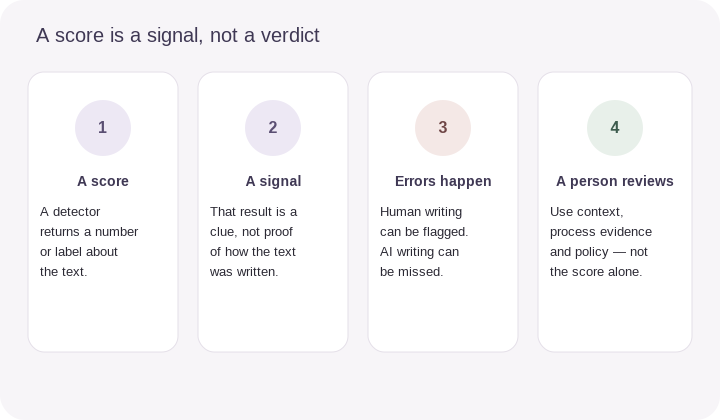
What the score is not
If you are a student, the most important sentence is this: a detector score is not automatically a finding that you cheated, and a low score is not a guarantee that your work will be accepted as fully human. Official pages we opened on 18 November 2026 say this in several ways. GPTZero’s official FAQ says results should not be used to punish students and should start a conversation. QuillBot’s official page says never to make an academic decision on a score alone. Grammarly’s official user guide says the percentage is not an objective source of truth and may differ from the tool your professor uses. Turnitin’s official blog says Turnitin does not determine misconduct.
Your course policy still governs what you are allowed to do. Some courses ban generative AI. Some allow it with disclosure. Some allow it only for planning. The MLA Style Center’s updated guidance tells writers to cite generative AI when they incorporate its content and to acknowledge other functional uses, such as editing or translation. Follow the rule you were actually given, and if the rule is unclear, ask before you submit — not after a flag.
Checking your own draft
Some students want to run a draft through a public detector before submitting, to see whether the writing looks “AI-like” to that tool. That can be a way to notice formal or generic passages you may want to revise in your own voice. It cannot certify that you are safe. Official pages warn that tools disagree, that short text is weaker evidence, and that grammar or rewrite tools can themselves affect a score.
If you did use AI, official ethics language from vendors such as QuillBot is to disclose that use rather than trying only to change the score. This site will not help you hide undisclosed AI use. If you did not use AI and you are worried because you write in a second language or in a very formal style, read Why false positives happen. The 2023 Liang et al. study, in the arXiv PDF we opened, found a high average false-positive rate on a set of human-written TOEFL essays in that experiment.
If you have already been flagged
Stay calm, read the policy, and gather drafts, notes and version history. Ask what other evidence is being considered and how you can respond. Official Turnitin guidance to instructors includes assuming positive intent when evidence is unclear. Jisc’s official principles say learners should have a way to contest the output of an AI system that affects their outcomes. For a fuller walkthrough, use If you are falsely flagged. That guide is educational; it is not legal advice and not a promise about your case.
One institutional example, not a universal rule: the University of Missouri’s official page records a Faculty Council opinion that AI detection reports should not be the sole evidence for reporting students or misconduct proceedings. Your school may have its own wording. Quote *your* policy, not this paragraph, in any formal response.
Frequently asked questions
If I got 0% on a free detector, can my teacher still question the work?
Yes. Official pages say tools can miss AI writing and can disagree with one another. Your teacher may also look at process, sources and the assignment design.
If I write in English as a second language, will I be flagged?
Not necessarily, but it is a documented risk in at least one 2023 study of seven detectors on TOEFL essays. If you are flagged, process evidence and a fair conversation matter. A score still is not proof.
Sources checked for this guide
- GPTZero official FAQ. Checked on 2026-11-18.
- QuillBot official AI Detector page. Checked on 2026-11-18.
- Grammarly Support, “AI Detector user guide”. Checked on 2026-11-18.
- Turnitin, “Understanding false positives in Turnitin AI detection”. Checked on 2026-11-18.
- MLA Style Center, “How do I cite generative AI in MLA style? (Updated and Revised)” (published 13 August 2025). Checked on 2026-11-18.
- Liang, Yuksekgönül, Mao, Wu and Zou, “GPT detectors are biased against non-native English writers,” arXiv:2304.02819 — We opened the arXiv abstract and the PDF (v3, 10 July 2023) on 18 November 2026. The authors point to the published Patterns article at https://www.cell.com/patterns/fulltext/S2666-3899(23)00130-7. Numbers quoted in the guides come from the arXiv PDF we opened, not from a Cell HTML full-text page.. Checked on 2026-11-18.
- Jisc, “Principles for the use of AI in FE colleges”. Checked on 2026-11-18.
- University of Missouri, “AI Detection Tools” (AI @ Mizzou). Checked on 2026-11-18.
Related guides
- If you are falsely flagged — Stay calm, keep your drafts, read the policy, and ask for a conversation. A score is not proof, and official sources say it should not stand alone.
- Why false positives happen — A false positive is human writing flagged as AI. Research and official vendor pages show this can happen, including for some non-native English writing.
- AI detection vs plagiarism checking — Plagiarism checking looks for copied text in a database. AI detection looks for patterns it associates with machine writing. They answer different questions.
All guides · All sources · How we review · Tools we point to