Guide
How AI detectors work
Main keyword: how AI detectors work. This is an educational guide, not a hands-on test and not a paid ranking. Sources were checked on 2026-11-18 unless a citation says otherwise.
Start with what a detector is trying to do
An AI text detector is a program that takes a piece of writing and returns a score, a label, or a highlight. The usual claim is that the result says something about whether the text was produced by a generative AI system, written by a person, or — in some newer tools — a mix of the two. That is a hard problem. Official pages and published research cited in this guide repeatedly warn that the result is incomplete evidence, not a courtroom-style proof.
It helps to separate three things people often mix together. First, there is the method: how the tool estimates a result. Second, there is the score or label you see. Third, there is the decision a school, editor or employer might make. This guide is about the first two. The decision still belongs to a person working under a stated policy. See How to read an AI detector score and How teachers can use results fairly.
Perplexity, explained carefully
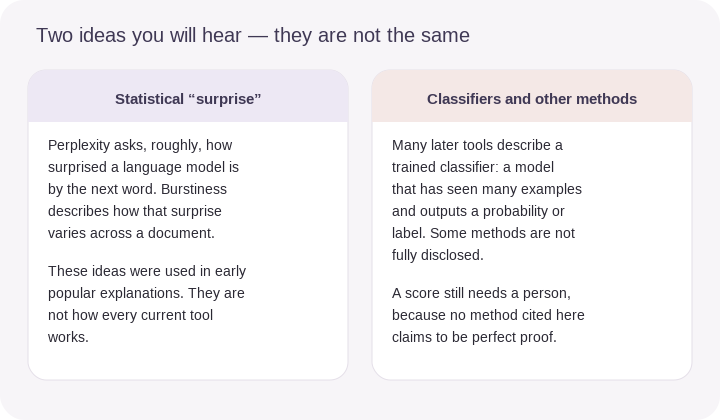
In language modelling, perplexity is a way of talking about how surprised a model is by the next word, given the words that came before it. If a model assigns a high probability to the actual next word, perplexity is lower: the text was predictable to that model. If the next word is unexpected, perplexity is higher. This is a statistical idea, not a moral judgement, and it is not a direct observation of a human author sitting at a keyboard.
An official GPTZero support article, checked on 18 November 2026, explains the idea in plain language: perplexity can be read as a measure of how likely an AI model would have chosen the same words, and it gives the example that a model might find “assistant” a low-perplexity continuation of “Hi there, I am an AI,” while “detector” would be more surprising. The same article is careful to say there is no absolute scale that everyone uses, even when older GPTZero versions reported a number.
Why did this idea get attached to detection? The intuition was that some AI writing can look unusually smooth or predictable to a language model, while some human writing looks more varied or surprising. That intuition is incomplete. Human writers also produce predictable prose — especially in formal school essays, formulaic business writing, or a second language with a narrower vocabulary. Published research has used low perplexity as part of the explanation for why some human essays were flagged. See Why false positives happen.
Burstiness, explained carefully
The same official GPTZero support article defines burstiness as a measure of how much perplexity varies over the whole document. The older popular story was that people often change rhythm, sentence length and word choice as they write, so their “surprise” goes up and down, while a model that keeps applying the same next-word rule may write with a more even level of predictability, or lower burstiness.
That story is a teaching aid, not a law of nature. People can write evenly. Models can be prompted, sampled, or edited so that their output is less even. And, as the next section explains, at least one well-known vendor says it no longer uses these two measures to make the detection decision.
Many current tools describe classifiers, not perplexity alone
It would be misleading to say “all AI detectors work by measuring perplexity and burstiness.” Some early public explanations leaned on those terms. Official pages we opened in November 2026 often describe something else: a classifier trained on examples of human and AI writing.
GPTZero’s official technology page says it uses “an end-to-end deep learning approach, trained on text datasets from the web, education, and AI-generated from a range of LLMs,” and that “a sentence-by-sentence classification model determines the probability and confidence that a text was created by AI.” The official support article on perplexity is even more direct: “As of autumn 2023, GPTZero no longer uses perplexity and burstiness for its AI detection because we migrated to a deep-learning based architecture.”
OpenAI’s 2023 text classifier, which the company later withdrew, was also described as a classifier: “a language model fine-tuned on a dataset of pairs of human-written text and AI-written text on the same topic.” Other vendors do not fully disclose their methods. When a company is silent, this site does not invent a pipeline for them.
What any of these methods still cannot do
OpenAI’s official page on its 2023 classifier, which we opened on 18 November 2026, is worth reading even though the tool itself was withdrawn on 20 July 2023 “due to its low rate of accuracy.” In the company’s own evaluations on a challenge set of English texts, the classifier correctly identified 26% of AI-written text as “likely AI-written” and incorrectly labelled human-written text as AI-written 9% of the time. The company wrote that “it is impossible to reliably detect all AI-written text,” that the tool should not be used as a primary decision-making tool, that it was very unreliable on short texts below 1,000 characters, worse in other languages, unreliable on code, weak on very predictable text, and that AI-written text can be edited to evade the classifier.
A later research paper, RAID (Dugan and colleagues, arXiv:2405.07940), which we opened on the same date, notes that many commercial and open-source models claim extremely high accuracy, “99% or more,” and then reports that current detectors are easily fooled by adversarial attacks, changes in sampling, repetition penalties, and unseen generative models. That is a finding from a shared benchmark paper, not a league table invented by this site.
The practical lesson is simple. Whether a tool talks about perplexity, a neural classifier, or a method it does not disclose, you still have a signal. You do not have a complete record of how the text was written. For what a score can and cannot mean, continue to What AI detectors cannot reliably prove.
Frequently asked questions
Do all AI detectors use perplexity and burstiness?
No. Those terms were used in early popular explanations, and GPTZero’s official support article says it stopped using them for detection as of autumn 2023 after moving to a deep-learning architecture.
If a text has low perplexity, was it written by AI?
Not necessarily. Low perplexity means a language model found the wording predictable. Human writing can also be predictable, which is one reason false positives happen.
Sources checked for this guide
- GPTZero Support, “How do I interpret burstiness or perplexity?”. Checked on 2026-11-18.
- GPTZero official technology page. Checked on 2026-11-18.
- OpenAI, “New AI classifier for indicating AI-written text” (31 January 2023; classifier withdrawn 20 July 2023). Checked on 2026-11-18.
- Dugan et al., “RAID: A Shared Benchmark for Robust Evaluation of Machine-Generated Text Detectors,” arXiv:2405.07940. Checked on 2026-11-18.
- Liang, Yuksekgönül, Mao, Wu and Zou, “GPT detectors are biased against non-native English writers,” arXiv:2304.02819 — We opened the arXiv abstract and the PDF (v3, 10 July 2023) on 18 November 2026. The authors point to the published Patterns article at https://www.cell.com/patterns/fulltext/S2666-3899(23)00130-7. Numbers quoted in the guides come from the arXiv PDF we opened, not from a Cell HTML full-text page.. Checked on 2026-11-18.
Related guides
- Why false positives happen — A false positive is human writing flagged as AI. Research and official vendor pages show this can happen, including for some non-native English writing.
- How to read an AI detector score — Read a score as an estimate with official limits attached. Check the length of the text, the vendor’s own warnings, and whether another tool or process evidence agrees.
- What AI detectors cannot reliably prove — Detectors cannot reliably prove that a person used AI, or that they did not. Official and research sources describe false positives, missed AI writing, and easy evasion.
All guides · All sources · How we review · Tools we point to