Guide
Policy and ethics of AI detection
Main keyword: AI detection policy. This is an educational guide, not a hands-on test and not a paid ranking. Sources were checked on 2026-11-18 unless a citation says otherwise.
The ethical problem in one sentence
AI detection is used in settings where people’s grades, jobs, publications or reputations can be affected, but the tools cannot, on the official and research evidence cited here, conclusively prove how a text was written. That gap — high stakes, incomplete evidence — is the ethical problem. A responsible policy faces it instead of pretending a percentage has settled the facts.
Jisc’s official principles, checked on 18 November 2026, place “contestability” among the requirements for colleges that use AI systems in ways that affect learner outcomes, including AI detection in assessment. Learners and staff should have clear guidance on how to contest an output if they feel unfairly disadvantaged. The same document’s section on academic integrity says detection tools “may have a part to play” but “are by no means a full solution,” that they can “unfairly discriminate and can compound existing bias,” and that they “cannot conclusively prove text was written by AI, generate false positives, and are easy to defeat.”
What a fair policy usually needs to say
A fair policy is specific. It says whether generative AI may be used, for which tasks, and how that use should be acknowledged. The MLA Style Center’s updated guidance (13 August 2025) recommends citing a generative AI tool when you paraphrase, quote or incorporate content it created, and acknowledging functional uses such as editing or translation. It also recommends not treating the tool as an author, and checking secondary sources the tool cites because AI systems can “hallucinate, or make up, sources.” That is a citation standard, not a law, but it is a public reference a policy can use.
A fair policy also says what a detector result will and will not be used for. The University of Missouri’s official page records a Faculty Council opinion that AI detection reports should not be the sole evidence in reporting students or in misconduct proceedings. Turnitin’s official blog says the vendor does not determine misconduct. GPTZero’s official FAQ says results should not be used to punish students. If a school uses a tool anyway, official Jisc wording is that staff need training on the limits.
Bias, access and disclosure
Bias is not only a technical footnote. Liang and colleagues (2023), in the arXiv PDF we opened, reported that seven detectors in their experiment misclassified more than half of a set of human-written TOEFL essays as AI-generated, and they cautioned against using such tools in evaluative or educational settings when they may penalise non-native English speakers. Jisc separately warns that detection can compound existing bias. A policy that ignores those warnings is not a complete policy.
Disclosure runs in more than one direction. Students and writers may be asked to say how they used AI. Institutions should also be transparent when they use AI systems in assessment or monitoring, which is part of Jisc’s official wording on transparency and explainability. Hidden detection, announced only after a flag, is harder to defend than a rule students can read in week one.
What this site will not do
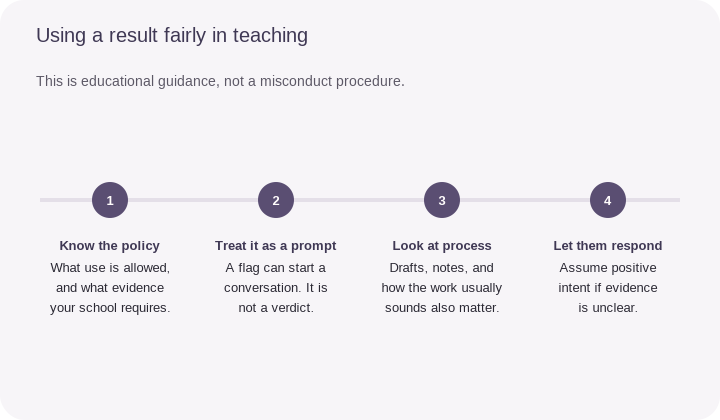
This site will not tell you how to hide undisclosed AI use, and it will not treat a detector as a moral authority. The ethical use of detection, on the sources we opened, is narrow: as one prompt among others, under a published policy, with a way to contest the result, and without pretending the tool has proved authorship. For classroom practice, see How teachers can use results fairly.
Frequently asked questions
Is there one universal AI detection policy?
No. Institutions set their own rules. This guide points to official examples and sector principles, not a single global standard.
Should a policy ban detectors entirely?
That is an institutional choice. Official sources cited here do not treat detectors as a full solution, and some warn they can discriminate. Any use, Jisc says, needs training and a way to contest the output.
Sources checked for this guide
- Jisc, “Principles for the use of AI in FE colleges”. Checked on 2026-11-18.
- University of Missouri, “AI Detection Tools” (AI @ Mizzou). Checked on 2026-11-18.
- MLA Style Center, “How do I cite generative AI in MLA style? (Updated and Revised)” (published 13 August 2025). Checked on 2026-11-18.
- Turnitin, “Understanding false positives in Turnitin AI detection”. Checked on 2026-11-18.
- GPTZero official FAQ. Checked on 2026-11-18.
- Liang, Yuksekgönül, Mao, Wu and Zou, “GPT detectors are biased against non-native English writers,” arXiv:2304.02819 — We opened the arXiv abstract and the PDF (v3, 10 July 2023) on 18 November 2026. The authors point to the published Patterns article at https://www.cell.com/patterns/fulltext/S2666-3899(23)00130-7. Numbers quoted in the guides come from the arXiv PDF we opened, not from a Cell HTML full-text page.. Checked on 2026-11-18.
Related guides
- How teachers can use results fairly — Treat a flag as a prompt for professional judgement, not a misconduct decision. Official sources say the score should not stand alone.
- If you are falsely flagged — Stay calm, keep your drafts, read the policy, and ask for a conversation. A score is not proof, and official sources say it should not stand alone.
- AI detection vs plagiarism checking — Plagiarism checking looks for copied text in a database. AI detection looks for patterns it associates with machine writing. They answer different questions.
All guides · All sources · How we review · Tools we point to