Guide
AI image detection in simple terms
Main keyword: AI image detection explained. This is an educational guide, not a hands-on test and not a paid ranking. Sources were checked on 2026-11-18 unless a citation says otherwise.
Two different ideas, often mixed together
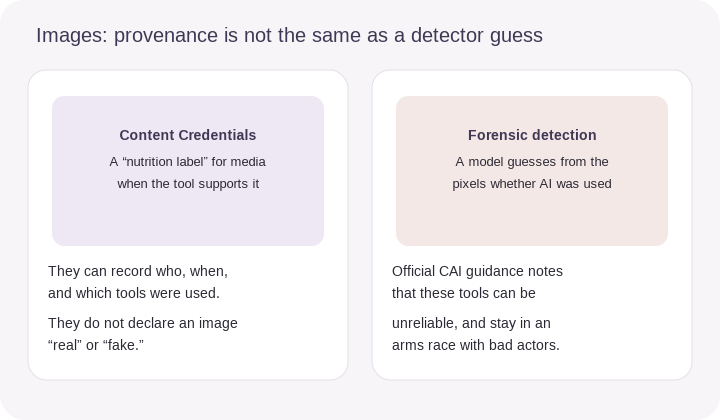
When people say “AI image detection,” they sometimes mean a tool that looks at an image and guesses whether it was generated or heavily altered by AI. That is a forensic or classifier-style guess, similar in spirit to a text detector: a model returns a score or a label. They sometimes mean something else: a provenance record attached to the file, describing who made it, when, and with which tools.
Those ideas should be kept apart. A guess can be wrong. A provenance record can be missing, stripped, or incomplete. Neither one, on the official explanation we opened, is a simple stamp that an image is “real.”
Content Credentials, in plain language
The Content Authenticity Initiative (CAI) official “How it works” page, checked on 18 November 2026, explains Content Credentials as “the verifiable metadata that the CAI’s tools help implementers generate, read, and display, based on the C2PA’s technical standards.” The same page calls them “essentially a nutrition label for digital content,” which can contain information about who produced a piece of content, when they produced it, and which tools and editing processes they used. The information depends on what each implementer supports and what the person applying the credentials chooses to include.
The official FAQ on that page asks, “Do Content Credentials indicate whether an image is fake or altered?” The answer is careful: they “provide information about the origin and history of a piece of content, but they aren’t intended to prescriptively indicate whether a piece of content is “real.”” If an AI tool supports Content Credentials, the credentials “can indicate that an image was generated with AI.” If a C2PA-enabled camera took the photo, that can be shown too, along with later edits made with supporting software. The page says this information is there so you can “form your own opinions and conclusions.”
Content Credentials are described as cryptographically signed and tamper-evident: if the content or the attached data is changed after signing, inspection tools should be able to show that something was altered. That is not the same as proving the underlying scene in a photograph really happened in the way you think it did. It is a record of what was signed, when it is present and intact.
Why forensic image detectors are not a complete answer
The same official CAI page asks, “Why aren't AI image detection tools the solution?” and answers: “While AI-generated image detection tools are valuable in some instances, their results can be unreliable. Detection tools will always be in an arms race against bad actors, requiring regular updates to improve their accuracy.” This site does not add invented accuracy numbers on top of that official caution.
OpenAI’s official page about its withdrawn text classifier also said the company was “currently researching more effective provenance techniques for text” and had “made a commitment to develop and deploy mechanisms that enable users to understand if audio or visual content is AI-generated.” That is useful context — a major model provider pointing toward provenance — but it is not a claim that provenance is already universal, or that every image you see online carries a trustworthy label.
For a reader, the practical habit is simple. If credentials are present, read them as a label, not as a verdict. If they are absent, do not assume the image is fake, and do not assume it is authentic. If a detector offers a score, treat it with the same caution you would give a text-detector score: a signal, not proof. This guide does not review individual image-detector products.
Frequently asked questions
If an image has Content Credentials, is it authentic?
Not automatically. Official CAI guidance says credentials can describe origin and history, including AI generation when the tool supports them, but they are not intended to say whether content is “real.”
If a detector says an image is AI-generated, is that proof?
Official CAI guidance says AI image detection results can be unreliable and that such tools remain in an arms race with bad actors.
Sources checked for this guide
- Content Authenticity Initiative, “How it works”. Checked on 2026-11-18.
- OpenAI, “New AI classifier for indicating AI-written text” (31 January 2023; classifier withdrawn 20 July 2023). Checked on 2026-11-18.
Related guides
- How AI detectors work — Perplexity and burstiness are useful ideas to understand, but many current tools describe classifiers or other methods. A score is still not proof.
- What AI detectors cannot reliably prove — Detectors cannot reliably prove that a person used AI, or that they did not. Official and research sources describe false positives, missed AI writing, and easy evasion.
- Policy and ethics of AI detection — Fair policy states what AI use is allowed, treats detector output as contestable, and does not let a score stand alone.
All guides · All sources · How we review · Tools we point to