Editorial status: AI-drafted text — pending human fact-check. Product facts that name a vendor were checked on official websites on 2026-11-18. We have not done hands-on testing unless a listing’s testing notes say otherwise. This notice will be removed only after a person has reviewed the wording.
Official vendor pages and sector guidance treat a detector result as incomplete evidence. Use it, if you use it at all, inside a published policy and a fair process.
Main keyword: AI detection for educators. This is educational guidance, not legal, academic-conduct or employment advice.
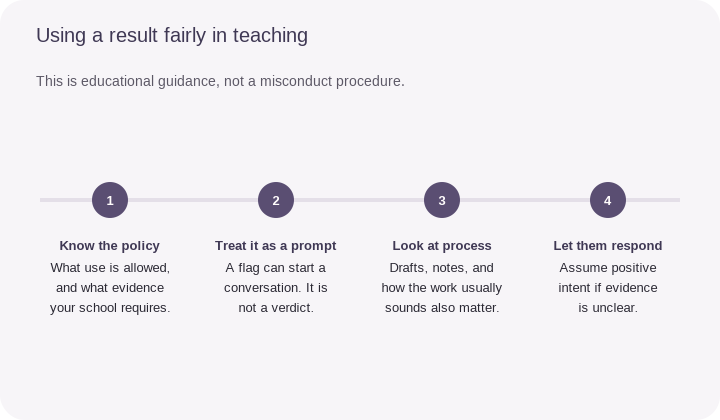
Fair use starts before a flag appears. Original diagram.
Start here
The main classroom guide is How teachers can use results fairly. Pair it with Policy and ethics when you are writing or revising a course rule. Jisc’s official principles say detection “may have a part to play” but is “by no means a full solution,” and that staff need training because tools cannot conclusively prove AI authorship, can generate false positives, and are easy to defeat.
If your institution already provides Turnitin, read the short official-pointer entry and Turnitin’s official blog on false positives, which says the company does not determine misconduct and asks instructors to apply professional judgment, assume positive intent, and plan for errors. If you are considering a self-serve tool as a conversation starter, GPTZero’s official FAQ uses that “conversation, not punishment” framing.
Guides in this hub
How teachers can use results fairly — Treat a flag as a prompt for professional judgement, not a misconduct decision. Official sources say the score should not stand alone.
Policy and ethics of AI detection — Fair policy states what AI use is allowed, treats detector output as contestable, and does not let a score stand alone.
Why false positives happen — A false positive is human writing flagged as AI. Research and official vendor pages show this can happen, including for some non-native English writing.
AI detection vs plagiarism checking — Plagiarism checking looks for copied text in a database. AI detection looks for patterns it associates with machine writing. They answer different questions.
What AI detectors cannot reliably prove — Detectors cannot reliably prove that a person used AI, or that they did not. Official and research sources describe false positives, missed AI writing, and easy evasion.
When writing is a mix of human and AI work — Many real drafts are mixed. Official tools sometimes offer a “mixed” label, but a score still cannot reliably separate every kind of help from authorship.
Tools this hub points to
For teachers and students who need a self-serve education-oriented official tool, still only as a conversation starter
An institutional tool. Official Turnitin guidance says it does not determine misconduct and that instructors must apply professional judgment because the false-positive rate is not zero.
Is this hub a product shortlist for classroom buying?
No. It is educational guidance. A couple of official websites are pointed to for teachers who already have, or are reading, those tools. This is not a catalogue and not a ranking.
This site stores your cookie choice in your browser (localStorage) so the banner does not keep reappearing. This site uses Google AdSense. Google and its partners may use cookies to serve ads, including personalised ads, based on your visits to this and other sites. You can opt out at Google Ads Settings and www.aboutads.info. Read the Privacy Policy. Datenschutzhinweis: Ihre Wahl wird nur auf diesem Gerät gespeichert.