Guide
If you are falsely flagged
Main keyword: flagged as AI written. This is an educational guide, not a hands-on test and not a paid ranking. Sources were checked on 2026-11-18 unless a citation says otherwise.
First, what this guide is and is not
This is educational and policy guidance for students, writers and other people who believe their own writing has been flagged in error. It is not a paste-your-text checking workflow, not a promise that we can clear your name, and not legal, academic-conduct or employment advice. If a formal process has started, use the process your school, publisher or employer actually has, and get advice from a person who is authorised to help you there.
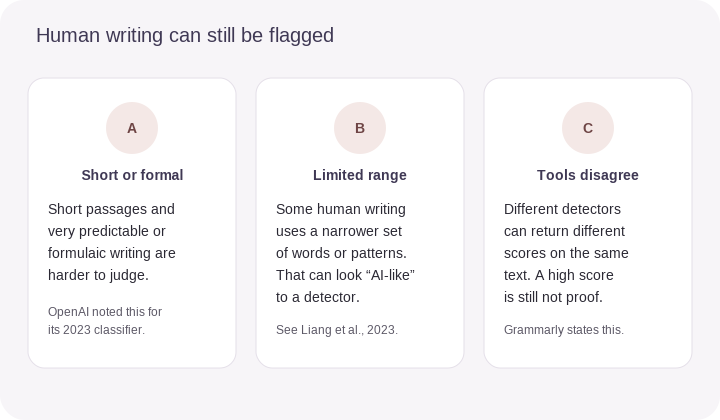
The starting point is documented, not hopeful. Official vendor pages we opened on 18 November 2026 say that detectors make mistakes. GPTZero’s official FAQ says results “should not be used to punish students” and that edge cases exist in both directions. QuillBot’s official page says you should never make an academic or employment decision on a detector score alone. Grammarly’s official user guide says the percentage is not an objective source of truth. Turnitin’s official blog says it does not determine misconduct and that the false-positive rate is not zero. Jisc’s official principles for colleges say detection tools “cannot conclusively prove text was written by AI, generate false positives, and are easy to defeat.”
What usually helps
The most useful material is usually evidence of process, not a second public detector score. Keep dated drafts, outlines, notes, reading annotations, and — if you wrote in a tool that stores version history, such as Google Docs — that history. GPTZero’s official FAQ, writing for educators who have found a positive detection, suggests asking whether the student can produce artifacts of the writing process, such as drafts, revision histories or brainstorming notes, and looking for a pattern rather than a single instance. You can offer that material even if nobody has asked yet.
Read the actual policy that applies to you: the syllabus, the academic-integrity page, the staff handbook, or the editor’s guidelines. Look for what the policy says about permitted AI use, about disclosure, and about how a concern is raised. If the policy says a detector report cannot be the only evidence, say so calmly and point to that wording. The University of Missouri’s official AI Detection Tools page, checked on 18 November 2026, is one institutional example: it is the opinion of the Faculty Council that AI detection software reports “should not be the sole evidence used for reporting students or misconduct proceedings.” Your institution may differ; the point is to read *your* rule, not to assume Missouri’s rule travels everywhere.
How to ask for a fair conversation
Turnitin’s official blog, addressed to instructors, is also useful if you are the person who has been flagged. Its published tips are: plan for the possibility of a false positive; “assume positive intent” and give students “the strong benefit of the doubt” if the evidence is unclear; and “be open and honest” that a false positive may occur, because denying that possibility makes the conversation more defensive. You can ask, politely, for that kind of conversation: What exactly was flagged? What other evidence is being considered? What is the process for responding?
Jisc’s official principles say colleges should ensure learners and staff have clear guidance on how to contest the output of an AI system if they feel they have been unfairly disadvantaged. If your college has adopted that idea, ask how to use it. Do not start by accusing anyone of bad faith. Do not try to “beat” the detector by running the text through a humanizer. QuillBot’s official page says that if AI contributed to your work, you should disclose it rather than revising only to change a score. If you did use AI, say so accurately. If you did not, say that clearly and offer process evidence.
A second public detector can sometimes show that tools disagree — Grammarly’s official user guide warns that scores may differ from Turnitin, GPTZero or Copyleaks — but a second score will not usually settle a formal case by itself. Treat it, at most, as a reason to slow down, not as a counter-proof.
If English is not your first language
You are not required to apologise for writing in a second language. The 2023 study by Liang and colleagues, in the arXiv PDF we opened, found that seven detectors in that experiment misclassified more than half of a set of human-written TOEFL essays as AI-generated, with an average false-positive rate of 61.22%. The authors caution against using such tools in evaluative or educational settings when they may penalise non-native English speakers. That paper does not automatically prove your specific case, and some vendors now publish later claims about reduced ESL bias. It does support a reasonable request: that a decision-maker take the risk of this kind of error seriously and look at more than a score.
If you usually write in a distinctive way, a previous assignment from the same course can also help a teacher compare voice and process, as Turnitin’s official guidance on professional judgment and knowledge of the student implies. Continue with AI detection for students if you want the wider student view.
Frequently asked questions
Should I run my essay through another public detector to prove I am innocent?
A second tool may disagree, which can be useful context, but official pages warn that scores are not verdicts and can differ across tools. Process evidence and the actual policy usually matter more.
Should I use a “humanizer” to lower a score?
This site does not recommend hiding undisclosed AI use or trying only to change a score. QuillBot’s official page says that if AI contributed, you should disclose it rather than revising to change a score.
Sources checked for this guide
- GPTZero official FAQ. Checked on 2026-11-18.
- QuillBot official AI Detector page. Checked on 2026-11-18.
- Grammarly Support, “AI Detector user guide”. Checked on 2026-11-18.
- Turnitin, “Understanding false positives in Turnitin AI detection”. Checked on 2026-11-18.
- Jisc, “Principles for the use of AI in FE colleges”. Checked on 2026-11-18.
- University of Missouri, “AI Detection Tools” (AI @ Mizzou). Checked on 2026-11-18.
- Liang, Yuksekgönül, Mao, Wu and Zou, “GPT detectors are biased against non-native English writers,” arXiv:2304.02819 — We opened the arXiv abstract and the PDF (v3, 10 July 2023) on 18 November 2026. The authors point to the published Patterns article at https://www.cell.com/patterns/fulltext/S2666-3899(23)00130-7. Numbers quoted in the guides come from the arXiv PDF we opened, not from a Cell HTML full-text page.. Checked on 2026-11-18.
Related guides
- Why false positives happen — A false positive is human writing flagged as AI. Research and official vendor pages show this can happen, including for some non-native English writing.
- AI detection for students: what a score does and does not mean — For students, a detector score is a signal, not a grade and not a finding of cheating. Read your course policy, keep your drafts, and disclose AI use if you used it.
- How teachers can use results fairly — Treat a flag as a prompt for professional judgement, not a misconduct decision. Official sources say the score should not stand alone.
All guides · All sources · How we review · Tools we point to