Guide
AI detection for writers and editors
Main keyword: AI detector for writers. This is an educational guide, not a hands-on test and not a paid ranking. Sources were checked on 2026-11-18 unless a citation says otherwise.
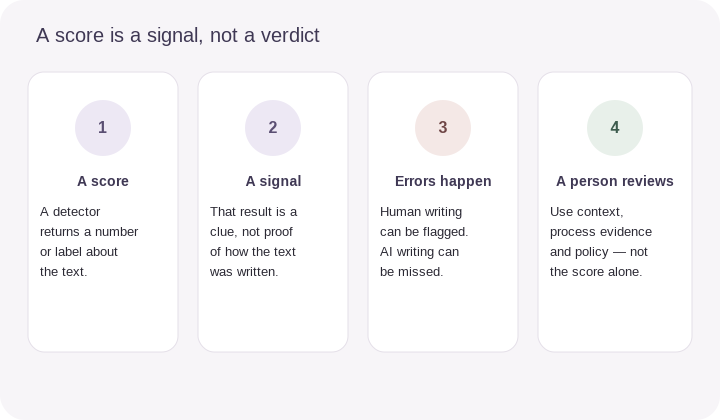
A score will not tell you if the work is worth publishing
Writers, editors and SEO publishers are sometimes asked to “run it through a detector” before a page goes live. That can be a reasonable extra look, especially if a freelancer or agency delivered the draft. It is a poor substitute for editing. Official detector pages themselves say a score is a signal, not a verdict, and that tools can flag human writing or miss edited AI writing. See How to read an AI detector score.
Google’s official Search Central guidance, “Google Search’s guidance on using generative AI content on your website,” was last updated on 1 October 2026 and was opened for this guide on 18 November 2026. Google says generative AI can be useful for research and for adding structure to original content, but that using such tools “to generate many pages without adding value for users may violate Google’s spam policy on scaled content abuse.” The page tells publishers to meet Search Essentials and spam policies, and to “focus on accuracy, quality, and relevance.”
What Google actually asks publishers to do
The same official Google page reminds publishers that “generative models don’t retrieve facts, but predict a likely sequence of words,” so outputs “may contain inaccuracies (also known as hallucinations).” It says “it is critical to manually factcheck and review all AI-generated content for accuracy and trustworthiness before publishing,” including metadata, titles, descriptions, structured data and image alt text that can appear in Search.
On disclosure, Google says “sharing information about how a piece of content was created can help give your readers more context,” and that if you automatically generate content you should consider explaining how, in a way that makes sense for your audience. That is official guidance about context for readers, not a requirement that a detector score appear on every page. This site’s own editorial flag — “AI-drafted, pending human fact-check” — follows the same spirit: say how the wording was produced, then have a person check it.
The official page also points to Google Merchant Center rules for some ecommerce uses, including metadata for AI-generated images. If you sell products, read that official policy on Google’s site; this guide does not replace it.
How a detector can still mislead a newsroom or content team
A low score on a thin, formulaic product page may say very little, because predictable text is hard to attribute — OpenAI made that point about its own classifier. A high score on a carefully edited human draft may reflect formal tone, or the use of an AI-assisted grammar tool. Originality.ai’s official site warns that some AI rewrite or edit tools can cause false positives. Grammarly’s official user guide says Grammarly’s own generative rewrites can raise its detector score.
If you work with contributors, a healthier workflow is: a written standard for permitted AI use and disclosure; a human edit and fact-check; then, if you choose, a detector as one more flag. The MLA Style Center’s updated citation guidance is a public reference for acknowledging AI-generated wording you actually use. QuillBot’s official page says that if AI contributed, disclose it rather than revising only to change a score.
This site points to a few official detector websites in short, task-based entries, including Originality.ai for a publishing-oriented official site and QuillBot and Grammarly for writers who already use those tools. Those entries are not rankings and not hands-on reviews.
Frequently asked questions
Does Google require a detector score on AI-assisted pages?
The official Google guidance we opened does not say that. It focuses on quality, accuracy, spam policies, fact-checking, and considering a disclosure about how content was created.
Can I use a detector instead of fact-checking?
No. Google’s official guidance says to manually fact-check AI-generated content because models predict words and can be inaccurate. A detector does not check facts.
Sources checked for this guide
- Google Search Central, “Google Search’s guidance on using generative AI content on your website” (page last updated 1 October 2026). Checked on 2026-11-18.
- QuillBot official AI Detector page. Checked on 2026-11-18.
- Originality.ai official homepage. Checked on 2026-11-18.
- Grammarly Support, “AI Detector user guide”. Checked on 2026-11-18.
- OpenAI, “New AI classifier for indicating AI-written text” (31 January 2023; classifier withdrawn 20 July 2023). Checked on 2026-11-18.
- MLA Style Center, “How do I cite generative AI in MLA style? (Updated and Revised)” (published 13 August 2025). Checked on 2026-11-18.
Related guides
- When writing is a mix of human and AI work — Many real drafts are mixed. Official tools sometimes offer a “mixed” label, but a score still cannot reliably separate every kind of help from authorship.
- How to read an AI detector score — Read a score as an estimate with official limits attached. Check the length of the text, the vendor’s own warnings, and whether another tool or process evidence agrees.
- Policy and ethics of AI detection — Fair policy states what AI use is allowed, treats detector output as contestable, and does not let a score stand alone.
All guides · All sources · How we review · Tools we point to