Guide
What AI detectors cannot reliably prove
Main keyword: limits of AI detection. This is an educational guide, not a hands-on test and not a paid ranking. Sources were checked on 2026-11-18 unless a citation says otherwise.
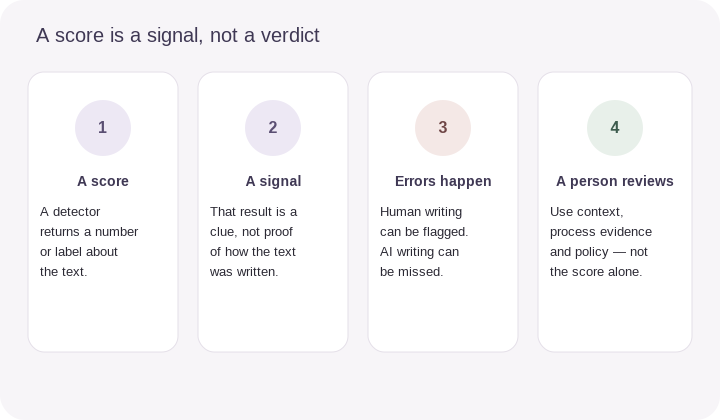
The limit in official language
OpenAI’s official page on its 2023 text classifier, checked on 18 November 2026, states the limit without decoration: “it is impossible to reliably detect all AI-written text.” The company withdrew that classifier on 20 July 2023 because of its low accuracy. In its own evaluation, the tool caught 26% of AI-written texts in a challenge set and falsely flagged human text 9% of the time, and OpenAI said it should not be used as a primary decision-making tool.
Jisc’s official principles say detection systems “cannot conclusively prove text was written by AI, generate false positives, and are easy to defeat.” GPTZero’s official FAQ, Grammarly’s official user guide, QuillBot’s official detector page, Scribbr’s official detector page and Turnitin’s official blog all, in their own words, warn that tools are not fully reliable, that scores should not stand alone, or that the vendor does not determine misconduct. This is not a fringe opinion on the pages we opened. It is the vendors’ and institutions’ own caution.
What a detector cannot see
A typical text detector does not see you type. It does not, unless a separate authorship or version-history product is used, watch the draft being built. It sees the finished words and compares them with patterns it has learned. That is why official pages talk about probabilities, signals and estimates rather than eyewitness proof.
It also cannot reliably see everything AI can do. OpenAI listed important failure modes for its classifier: short text, other languages, code, very predictable text, edited AI text, and inputs far from the training data, where a neural classifier can be “extremely confident in a wrong prediction.” The RAID benchmark paper we opened finds that detectors can be fooled by adversarial attacks, sampling changes, repetition penalties and unseen generative models. GPTZero’s official FAQ says its model is not trained to identify heavily modified AI text and is stronger on English prose than on every other kind of writing.
High advertised accuracy does not cancel those limits
The RAID paper’s abstract notes that many commercial and open-source models “claim to detect machine-generated text with extremely high accuracy (99% or more).” You will see similar figures on some official marketing pages we opened. This site records those figures, when we mention them at all, as vendor claims. They are not our tests, and a benchmark number from one dataset does not erase the official warnings on the same or sister pages about false positives and sole-evidence decisions.
The useful conclusion is modest. Detectors can still be a reason to look more closely. They cannot reliably prove authorship, intent, or that a human writer is “in the clear.” For the classroom implications, see How teachers can use results fairly. For images, which have a separate provenance story, see AI image detection in simple terms.
Frequently asked questions
Has any official source said detection can be 100% reliable?
The official pages we opened go the other way. OpenAI wrote that it is impossible to reliably detect all AI-written text. Several vendors say no detector is 100% accurate or that a score is not a verdict.
If a vendor claims 99% accuracy, can I treat a flag as proof?
No. This site treats such figures as vendor claims, and official pages from vendors and institutions still warn against using a score as the only evidence.
Sources checked for this guide
- OpenAI, “New AI classifier for indicating AI-written text” (31 January 2023; classifier withdrawn 20 July 2023). Checked on 2026-11-18.
- Jisc, “Principles for the use of AI in FE colleges”. Checked on 2026-11-18.
- GPTZero official FAQ. Checked on 2026-11-18.
- Grammarly Support, “AI Detector user guide”. Checked on 2026-11-18.
- QuillBot official AI Detector page. Checked on 2026-11-18.
- Scribbr official AI Detector page. Checked on 2026-11-18.
- Turnitin, “Understanding false positives in Turnitin AI detection”. Checked on 2026-11-18.
- Dugan et al., “RAID: A Shared Benchmark for Robust Evaluation of Machine-Generated Text Detectors,” arXiv:2405.07940. Checked on 2026-11-18.
Related guides
- How to read an AI detector score — Read a score as an estimate with official limits attached. Check the length of the text, the vendor’s own warnings, and whether another tool or process evidence agrees.
- Why false positives happen — A false positive is human writing flagged as AI. Research and official vendor pages show this can happen, including for some non-native English writing.
- AI image detection in simple terms — Content Credentials can record how an image was made when they are present. Forensic detectors guess from the pixels and, official guidance says, can be unreliable.
All guides · All sources · How we review · Tools we point to