Tool we point to — not a full product review
GPTZero
For teachers and students who need a self-serve education-oriented official tool, still only as a conversation starter
Visit official website All tools we point to
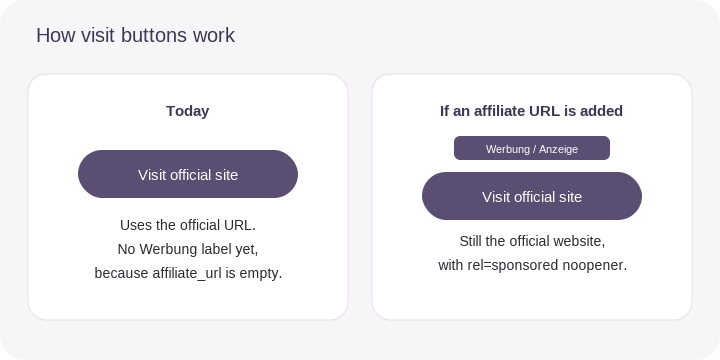
This visit button uses the official website. An affiliate_url placeholder is empty until a programme on Impact, PartnerStack or Awin is joined.
Why this site points here
GPTZero’s official FAQ, checked on 18 November 2026, says the classifier is intended to flag situations in which a conversation can be started — for example, between educators and students — and that results should not be used to punish students. The same FAQ says there are always edge cases in both directions: AI writing classified as human, and human writing classified as AI.
GPTZero’s official technology page describes an end-to-end deep-learning, sentence-by-sentence classifier, not a simple perplexity score. A separate official support article says that as of autumn 2023 GPTZero no longer uses perplexity and burstiness for detection, after moving to a deep-learning architecture. Those older terms still appear in popular explanations, which is why this site explains them carefully in the “how detectors work” guide.
Figures published by GPTZero, such as a claimed false-positive rate of no more than 1% or a claimed 1.1% false-positive rate on TOEFL texts after de-biasing work, are vendor claims from official pages we opened. They are not independent tests by this site, and they do not make a score into proof.
When this official site may help
- You want to read an official education-oriented FAQ before a teacher–student conversation about a score.
- You want current official language on how this particular tool says it works (a classifier, not perplexity alone).
Limits to keep in mind
- The official FAQ says results should not be used to punish students and that edge cases exist in both directions.
- The official FAQ says the model is stronger on longer text and on English prose written by adults, and is not trained to identify heavily modified AI text.
- Vendor accuracy and false-positive figures are claims, not this site’s tests.
What the official site itself warns
GPTZero’s official FAQ says: “these results should not be used to punish students.” It also says there always exist edge cases where AI is classified as human and human writing is classified as AI, and that the classifier is intended to flag situations in which a conversation can be started.
Official source: https://gptzero.me/faq · checked on 2026-11-18
Hands-on testing notes
To be filled after hands-on test.
This site does not claim to have used the product until this box is filled in by a person after a real test.
Frequently asked questions
Does GPTZero still detect with perplexity and burstiness?
An official GPTZero support article, checked on 18 November 2026, says that as of autumn 2023 it no longer uses those measures for detection and migrated to a deep-learning architecture.
Guides that give this entry context
- How AI detectors work — Perplexity and burstiness are useful ideas to understand, but many current tools describe classifiers or other methods. A score is still not proof.
- How teachers can use results fairly — Treat a flag as a prompt for professional judgement, not a misconduct decision. Official sources say the score should not stand alone.
- Why false positives happen — A false positive is human writing flagged as AI. Research and official vendor pages show this can happen, including for some non-native English writing.
Official pages used for this entry
These citation links always use the plain official URL, even after an affiliate visit button is added.