Tool we point to — not a full product review
Grammarly AI Detector
For writers already working in Grammarly, who need to know that scores can differ across tools
Visit official website All tools we point to
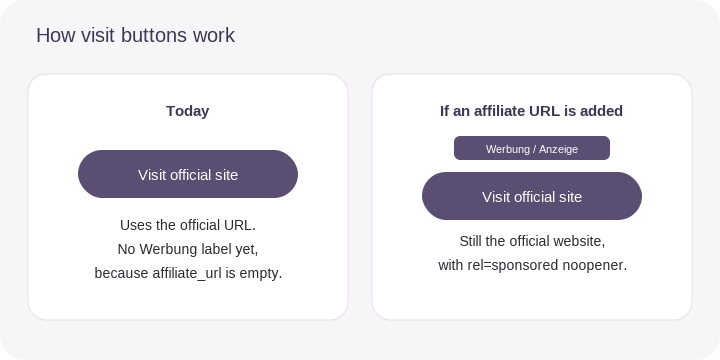
This visit button uses the official website. An affiliate_url placeholder is empty until a programme on Impact, PartnerStack or Awin is joined.
Why this site points here
Grammarly’s official AI Detector page and official user guide, both checked on 18 November 2026, describe a score as the percentage of scanned text that appears AI-generated. The official product page presents the feature as free in marketing language, but the official user guide says access can depend on your plan and on how your organisation has enabled features. This short entry does not quote a Grammarly plan price as if it were a detector-only fee.
The official user guide is the reason this site points here for writers already in that workflow. It says the percentage “should not be used as an objective source of truth, as AI detection of any kind can be prone to errors.” It also says the feature is not 100% accurate and should not be used as a definitive assessment, and that scores may differ from those of other solutions such as Turnitin, GPTZero and Copyleaks. You should not assume your teacher will see the same score.
The same official guide notes that Grammarly’s own generative rewrites can raise the AI-detection score, because those rewrites come from an LLM. The official product page also states that no AI detector is 100% accurate, that human-written text can be flagged, that lightly edited AI text may evade detection, and that AI detection should never be used as a standalone verification method. Marketing claims such as 99% accuracy or a “#1” RAID ranking on the product page are vendor claims, not tests by this site.
When this official site may help
- You already write in Grammarly and want to understand what its official detector score does and does not mean.
- You need official language that scores can differ from another detector your school or editor uses.
Limits to keep in mind
- Official guidance: the percentage is not an objective source of truth and is not 100% accurate.
- Access can depend on plan or organisation settings, according to the official user guide.
- Official guidance: Grammarly generative rewrites can themselves be flagged.
What the official site itself warns
Grammarly’s official user guide says the percentage result “should not be used as an objective source of truth, as AI detection of any kind can be prone to errors,” and that the feature “is not 100% accurate and should not be used as a definitive assessment.” It also says scores may differ from Turnitin, GPTZero, Copyleaks and others, and that you should not view a Grammarly score as a clear indication that a professor will see the same score.
Official source: https://support.grammarly.com/hc/en-us/articles/28936304999949-AI-Detector-user-guide · checked on 2026-11-18
Hands-on testing notes
To be filled after hands-on test.
This site does not claim to have used the product until this box is filled in by a person after a real test.
Frequently asked questions
If Grammarly gives a low score, will Turnitin agree?
Not necessarily. Grammarly’s official user guide says scores may differ from Turnitin, GPTZero and Copyleaks, and should not be treated as a prediction of another detector’s result.
Guides that give this entry context
- How to read an AI detector score — Read a score as an estimate with official limits attached. Check the length of the text, the vendor’s own warnings, and whether another tool or process evidence agrees.
- AI detection for writers and editors — For publishing, quality and disclosure matter more than a detector score. Google’s official guidance focuses on helpful, accurate, people-first content, not on a percentage.
- When writing is a mix of human and AI work — Many real drafts are mixed. Official tools sometimes offer a “mixed” label, but a score still cannot reliably separate every kind of help from authorship.
Official pages used for this entry
These citation links always use the plain official URL, even after an affiliate visit button is added.